Polaris
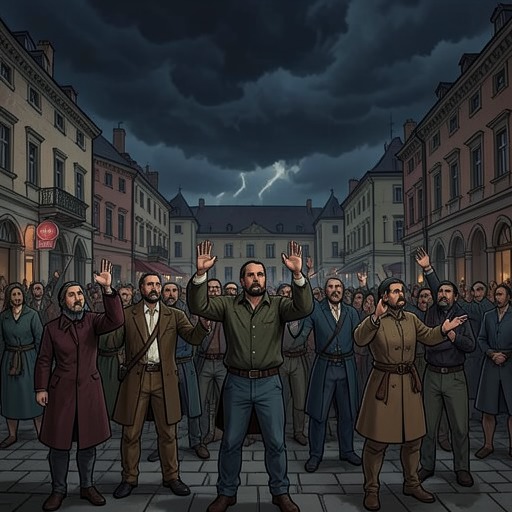
Foucault's PendulumPolaris is a group that Vivian Postel du Mas and Jeanne Canudo are said to have founded in 1929, inspired by the myth of the King of the World. Its proposed synarchic program joined cooperative, communitarian reform to opposition to capitalist profit and class conflict. In Casaubon’s account, Polaris becomes a revealing case in the novel’s history of synarchy: a movement whose public reformist ideas are repeatedly recast as evidence of a secret conspiracy.
Origins and Program
Casaubon encounters Polaris while tracing the disputed political meanings of synarchy. He describes its founders’ proposal as social service opposed to capitalist profit and the elimination of class struggle through cooperatives. The program strikes him as resembling Fabian socialism and libertarian communitarianism, rather than a straightforward authoritarian design. Its inspiration in the King of the World myth, however, also places it within the esoteric vocabulary that makes synarchy vulnerable to increasingly expansive interpretations.
Political Accusations and Contradictions
The account of Polaris is set against a chain of accusations that crosses the political spectrum. Both Polaris and the Irish Fabians, Casaubon says, were accused of participating in a synarchic plot led by Jews. The accusations came from a review that promoted the idea of a Jewish-Masonic-Bolshevik conspiracy; some of its contributors belonged to La Sapinière, a secret right-wing organization. In that account, revolutionary movements themselves became fronts for an occultist group. Casaubon finds the charge difficult to reconcile with what he has read about occultists’ apparent lack of interest in the workers’ movement.
The surrounding history deepens rather than resolves the contradiction. Casaubon recounts that later synarchic groups in the 1940s called for a new European order governed by wise men above party politics and met in Vichy collaborationist circles. Yet the synarchic pact associated with Du Mas and Canudo was denounced as a secret socialist project even though its ideas had been published openly. The episode shows how the designation of secrecy can be imposed on public material, and how the same supposed hidden power can be labeled left-wing, right-wing, or occult depending on the accuser.
Place in the Novel’s Conspiracy Logic
Polaris is not developed through scenes of its members acting together; it enters the novel through Casaubon’s research and his attempt to sort conflicting reports. Its significance lies in the instability of the political labels surrounding it. A reformist cooperative program is drawn into a conspiracy narrative that converts reform, occultism, and political opposition into signs of a single concealed authority. As Casaubon follows the claims, each apparent clarification produces another incompatible explanation. Polaris thus exemplifies the novel’s danger of treating repeated accusations and parallels as confirmation rather than as evidence requiring distinction.